
 Posted by
 By Daisy Brasington BSc
3rd June 2025
Prepared for Fund4Trees, Registered Charity 1152318
PRESS RELEASE
Fund4Trees calls for a nationwide cultural shift away from ‘plant and walk away’ to focus on tree establishment
In the UK, research documenting poor tree establishment and high tree mortality rates in the urban environment was first published over 40 years ago, with one Scottish study reporting only 54% survival after five years (2). Since then, similar research has documented failure rates of 20–50% for newly planted urban trees (3 & 4). This level of mortality is clearly unacceptable.
Arboricultural professionals suggest that insufficient funding for aftercare is contributing to high mortality rates. In 2023, a Fund4Trees (F4T) sponsored survey undertaken at the National Tree Officers Association conference found that tree officers largely agreed with the statement “A lack of revenue funding to ensure post-planting maintenance is an issue impacting successful tree establishment” (5).
Subsequently, Fund4Trees wanted to further explore the efficacy of tree establishment and in 2024 awarded a research grant to Daisy Brasington to investigate the success of tree establishment in the urban environment between 2012 and 2022 (1). This research focused on grant-funding-led and development-led tree planting at 820 planting locations at 48 sites across four cities: Bristol, Birmingham, Nottingham, and Leeds. This is the first time research which retrospectively investigates the survival and condition of multiple cohorts of recently planted trees across different cities has been undertaken.
Key findings
On development sites, 23% of the trees specified on approved planting schemes had not been planted at all. In one of the cities, 42% of the proposed Urban Tree Challenge Fund trees appeared not to have been planted (or had died and been removed already).
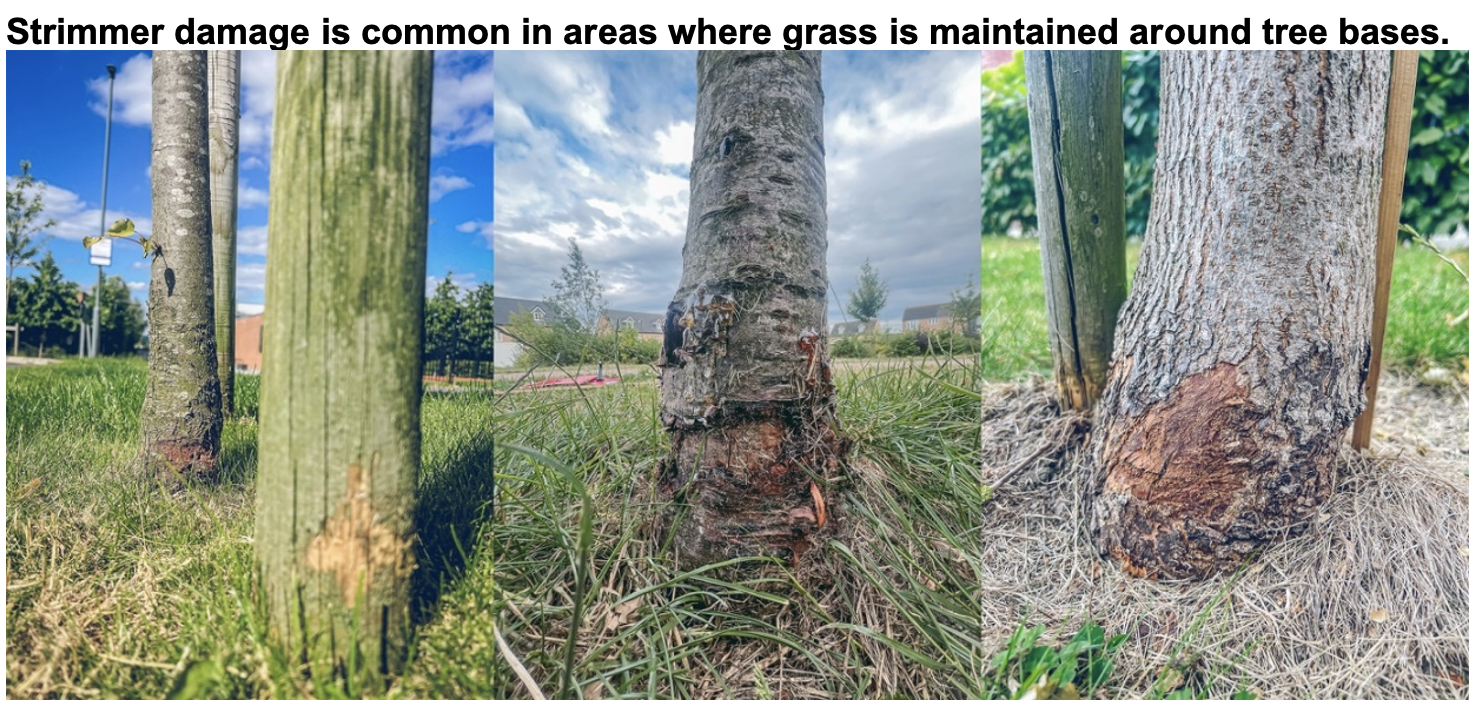
Of the 687 trees across all locations which were actually planted from either funding source, just 79% had survived.However, only 42% were found to be growing in good condition and a mere 3% of the trees were ‘unscathed’ (e.g. had no dieback, chlorosis or other signs of obvious stress as measured by the survey). Trees planted at new housing developments were significantly more likely to be in poor condition than trees planted using a grant, though a similar percentage from either funding source were found to have died. Various types of tree damage were widely encountered during the surveys including from strimmers or mowers and due to poorly installed or badly maintained supports and guards (see appended photos).
The report also highlighted average annual mortality rates of 5–7%. With such losses, for every 20 trees planted today only four would remain after 30 years. The promise of societal and environmental benefit from tree planting will not be achieved with such poor performance, nor without a drastic change in industry practices.
To address this unacceptably poor establishment rate, the F4T research report recommends:
- The provision of sufficient revenue funding for post-planting maintenance.
- Addressing mower/strimmer damage.
- Correct staking at planting, with timely de-staking.
Our report also calls for the appraisal of more urban planting schemes, in support of learning lessons and driving success across the urban treescape.
Tree planting must also observe industry standard BS 8545 (6). Additionally, we should be implementing post-planting monitoring to assess the condition of these trees and to ensure both their successful establishment and their long-term health. Crucially, to achieve this success we should engage communities in urban tree planting schemes and their aftercare.
In 40 years it appears little has changed. Recurrent failures continue to erode the long-term value of tree planting programmes that seek to improve the urban environment and the lives of everyone in our communities.
This is clearly unacceptable: a nationwide cultural shift towards ensuring newly planted trees receive sufficient monitoring and maintenance to reach maturity is essential to improve the efficacy of tree planting in urban environments. The current trend of plant and walk away must end.
Dr Kieron Doick, Head of the Urban Forest Research Group at Forest Research, said: “It has been my pleasure to support Daisy as an early careers researcher on her journey to fulfil this important project. She has invested substantial time and thought. Her dedication has led to a vitally important report highlighting historic failings in tree establishment practice over the past decade. We know that in recent years there has been a change in emphasis, including amongst funders, to move from ‘tree planting’ to ‘tree establishment’, yet the findings in this report will be invaluable still to funders and practitioners alike. Promised trees not being planted, chlorosis, lower trunk damage and dieback are things that should concern us all if we wish to see a healthy resilient landscape in our towns in the future. I hope that funders from all variety of sectors will support future evaluations of both the progress of the trees considered in this project and of those planted in more recent times, so that we may attain successful tree establishment for the benefit of society. My thanks to Fund4Trees for making this research possible.”
Dr Jon Banks, Research Lab Manager for the UK Bartlett Tree Research Laboratory, said: “This research by Daisy Brasington offers a timely and sobering insight into the challenges of urban tree establishment. It underscores the need for rigorous standards in planting and importance of aftercare and maintenance if we are to realise the long-term benefits of urban greening. The clear evidence this work provides can now guide both funders, researchers, and practitioners toward more successful and resilient urban landscapes.”
Russell Ball
Fund4Trees russell@fund4trees.org.uk
References
- Brasington, D. (2025). Evaluation of the Success of Urban Tree Planting in England between 2012 and 2022. Fund4Trees, Oxford. pp 79. Available from: [http://bit.ly/3I3ZrUp]
- Skinner, D. N. (1979). Planting Success Rates-Standard Trees. Arboriculture Research Note 66. Accessed via https://www.trees.org.uk/Trees.org.uk/files/4e/4e5f2a54-f016-408a-b520-1b965f175924.pdf, 9th October 2024.
- Britt, C., & Johnston, M. (2008). Trees in Towns II: A new survey of urban trees in England and their condition and management. Communities and Local Government Publications, London.
- Walker, H., & Sparrow K. (2023). What can tree inventories tell us? ARB Magazine 200: 55–59
- Brasington, D. (2023). Tree establishment: survey of tree officers. ARB Magazine 201: 58–59
- The British Standards Institution (2014). BS 8545: Trees: from nursery to independence in the landscape – recommendations.
- The report’s author: Daisy Brasington (BSc) is Director of Remember The Future and provides photography and communication services for the sustainability and arboricultural sectors, often working with Crown Tree Consultancy and Avon Needs Trees.
- Project supervision was provided by Dr Kieron Doick, Head of the Urban Forest Research Group at Forest Research, and Dr Jon Banks, the Research Lab. Manager for the UK Bartlett Tree Research Laboratory. Both are also members of the Fund4Trees Research Advisory Committee.
- Fund4Trees (https://fund4trees.org.uk/) is a registered charity (no. 1152318) that promotes sustainable treescapes.
REPORT’S EXECUTIVE SUMMARY
Government-backed environmental improvement programmes allocate substantial resources to planting new trees in urban locations to improve population welfare and support climate change adaptation. Alongside this, new trees are regularly planted to mitigate the loss of existing ecosystem services during new development.
These activities are often widely publicised to stakeholders and the public at the time of planting, while long-term outcomes have seldom been investigated. High mortality rates significantly affect a tree-planting programme’s ability to provide long-term ecological benefits. Results of a Scottish Development Agency survey of standard and larger trees planted on land owned and managed by the local authority in 1979 revealed only 54% survival after five years (Skinner, 1979).
In 1985, a planted cohort re-investigation revealed that just 28% of the population was growing physically unscathed, with water and nutrient stress affecting over half the trees (Gilbertson & Bradshaw, 1985). Trees and Towns II reported an estimated average mortality rate of 20% for newly planted trees (Britt & Johnston, 2009), and interrogation of available tree inventory data from 2014–2022 showed mortality rates between 20% and 50% for newly or recently planted trees (Walker & Sparrow, 2023).
This project investigates the success of grant-funding-led and development-led urban tree planting efforts which took place between 2012 and 2022. The project investigated 820 planting locations at 48 sites across four cities: Bristol, Birmingham, Nottingham, and Leeds. This is the first time research which retrospectively investigates the survival and condition of multiple cohorts of recently planted trees across different cities has been carried out.
Objectives included determining whether specified cohorts of trees (from each of the two funding sources) had been planted, if the planted trees had survived, and systematically describing the tree, site, planting and post-planting maintenance characteristics using structured observations. The trees were surveyed using an adapted version of the Planted Tree Re-Inventory Protocol (PTRP), developed by the Bloomington Urban Forest Research Group, which was specifically designed to measure factors which influence tree establishment in the urban environment.
Chi-squared tests of independence were used to look for significant differences in variable prevalence based on the funding source, and multiple variables’ effects on condition outcome were investigated in the same way. Post hoc tests using standardised residuals were carried out to identify significant results. p<0.05 was used to determine significant findings.

 Fund4Trees