
By Pherenice Worsey-Buck
Introduction
During late October, 2023, I was privileged to attend the 2nd World Forum on Urban Forests (https://www.worldforumonurbanforests.org) in Washington DC. The Forum explored the theme of ‘greener, healthier and happier cities for all’, bringing together over 1200 attendees from across 61 countries for five days to discuss the latest research, share experiences and exchange knowledge on urban forests and trees.
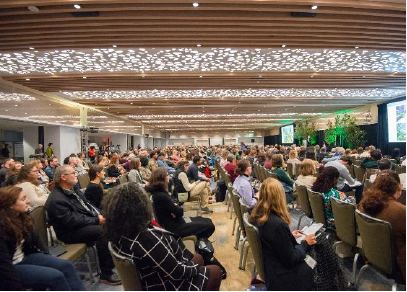
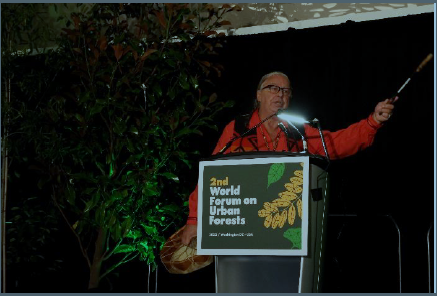
The announcement of an historic investment of $1.5 billion by the Biden-Harris administration days before the event “to increase urban tree cover, boost equitable access to nature, and tackle the climate crisis” through 400 projects across America gave the Forum a sense of excited anticipation. As Chief Mark Tayac, of 29th Generation Chief of the Piscataway Indian Nation, the indigenous people of Maryland, greeted delegates with a traditional Piscataway welcome, you knew this was going to be no ordinary event. Each day explored a different theme as the audience were challenged to learn, share and connect with others. With over 160 inspiring speakers who gave presentations, ran workshop sessions or led fringe events, it’s been a difficult task to highlight just a few that really stood out for me, but here goes.
Day 1 – Healthier Cities
The first day’s theme was how urban forests contribute to public health by creating healthy cities and healthy people. Many examples of evidence-based approaches from around the world were shared. Being a huge fan of Dr Frances (Ming) Kuo, since reading her published work on the effects of urban greening on reducing crime, aggression, and violence in Chicago (Kuo, Ming & Sullivan, William. 2001. Aggression and Violence in the Inner City. Environment and Behaviour – ENVIRON BEHAV. 33. 543-571); I was very excited to see her latest work. Ming’s presentation on “Maximising green person-minutes” looked at how exposure to nature
boosts the human immune system to promote health. By taking blood tests before and after exposure to different environments and studying ‘Natural Killer’ cells which play an important protective role in cancer, viral infections and other health outcomes, studies showed that just five minutes of exposure to ‘nature’ was enough to change a person’s flight/fight response towards a calmer state. The longer the exposure to nature, the better the longer-term health benefits, which got me thinking how we in the Arboricultural Association might want to research and explore the most impactful places that we can plant trees to benefit our communities in the UK. Another study linking nature with health was the “Green Heart Louisville Project” led by Dr Aruni Bhatnagar at the Department of Medicine, University of Louisville. Aruni introduced us to the emerging field of Environmental Cardiology, which studies the link between pollution and chronic heart disease. The central hypothesis was that exposure to neighbourhood greenery diminishes the risk of cardiovascular disease by decreasing the levels of air pollution. The amount of data captured and analysed was outstanding; they assessed the impact of neighbourhood greenness on air quality and noise and monitored changes in community health measurements. Various environmental parameters such as air pollutants, noise and greenness were measured before, during, and after large-scale planting. The scale and volume of planting was colossal. A multimillion-dollar investment allowed them to undertake neighbourhood greening across six neighbourhoods by planting thousands of large mature trees (visualise 18-foot Norway Spruce), as well as young trees, shrubs and grasses in residential and business areas, gardens, open spaces, along streets and screening the motorways. In parallel with this, the health parameters of the local community were also measured which included blood pressure, lipids, obesity and diabetes, cardiovascular risk and biomarkers of cardiovascular injury.

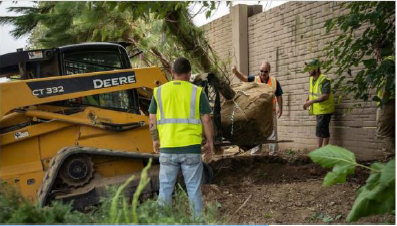

Presentation slides of large trees transplanted in Louisville by Dr Aruni Bhatnagar (photo: Green Heart Project Louisville)
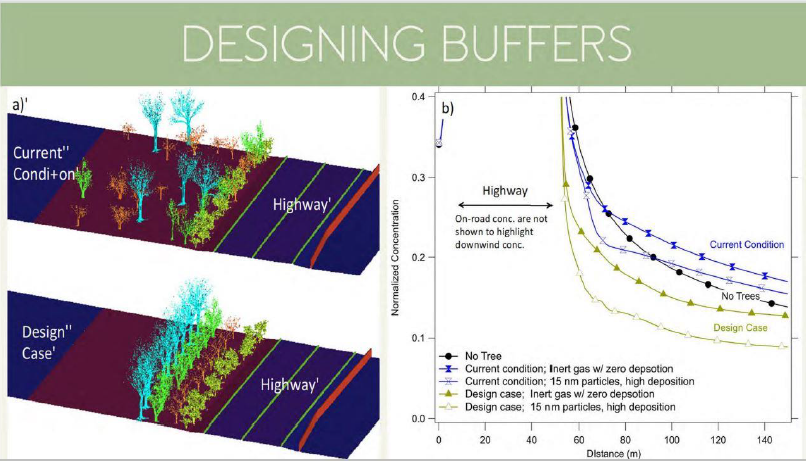
But wait, there’s more! They also studied how much particulate matter was captured by different plants, shrubs and trees to observe variations in the planting design and gradients to ensure trees were planted to optimise the removal of air pollutants. I did mention that the scale of the project was huge, and I would encourage you to look at https://greenheartlouisville.com to see how they are using this information to guide the development of nature-based planning to maximise the removal of air pollutants, help prevent heart disease and other chronic health conditions, reduce mental stress, increase community cohesion, encourage physical activity, reduce energy use and mitigate heat islands. According to the UN’s World Health Organisation, cardiovascular disease is the leading cause of death globally; a UK study by Mitchell & Popham (2008) reported that the rate of cardiovascular mortality in the least-green areas was twice that of the greenest environments. With 60-80% of cardiovascular disease preventable by improving environmental conditions, suddenly nature seems no longer a luxury but a vital living infrastructure for future healthy city-living.
Day 2 – Inclusive Cities
On day two, the theme was inclusive cities; we heard about many different urban forest tools that can help decision-makers get more trees into the communities that need them. Cecil Konijnendijk, the Director and Co-founder of the Nature-Based Solutions Institute (http://nbsi.eu), introduced the now world-famous 3:30:300 rule for greener and healthier urban spaces. He gave a compelling speech about bringing trees back into our lives at a neighbourhood, street and garden level. This guiding principle requires that everyone should
be able to see 3 large trees from their home; we should aim for 30% canopy cover in our neighbourhoods, and green space should be no further than 300 metres away. This rule-of-thumb is really building momentum and is being adopted in city-wide strategies around the world (at least one third of all municipalities in The Netherlands are using the rule). This is mainly due to its simplicity to understand and communicate the positive impact urban-greening has on health, wellbeing, and resilience. In Scotland, a new £10m urban forestry programme is being developed through Future Woodlands Scotland using the 3:30:300 rule as a key target to create accessible green space where it will most benefit communities and deliver environmental, social and economic benefits (https://www.futurewoodlands.org.uk/funding/urban-forestry-programme).

Since the Covid-19 pandemic, people have realised the full value that trees, woodlands and green spaces can bring to their health and wellbeing. But we also heard about ‘tree inequity’ where there have been decades of under-investment in neighbourhoods, resulting in communities being impacted by extreme heat, pollution and flooding, with no access to the benefits that urban forests can bring. American Forests have developed the Tree Equity Score, covering all urban areas in the United States where approximately 80% of the population lives. Each score indicates whether there are enough trees in a neighbourhood for everyone to experience the health, economic and climate benefits that trees provide. Scores are based on tree canopy, surface temperature, income, employment, race, age, language and health factors. This urban forest tool is fast becoming a global ‘tree equity’ movement, led by Jad Daley, CEO, at American Forests. In December 2023, The UK Tree Equity project was launched with all urban areas where the population live in the UK mapped and scored; the data is freely available at https://uk.treeequityscore.org/.
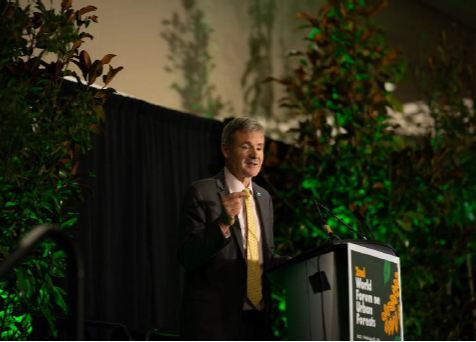
The success of the US Tree Equity project is based on urban forest advocacy, building partnerships, securing funding, and a collaborative approach with local communities at the heart of the planning and growing of their trees. The training and employment of local people is a key project component; it will be exciting if this is replicated here. The challenge in the UK will be maintaining the trees once planted, as stewardship is key for the future success of any urban forest programme.
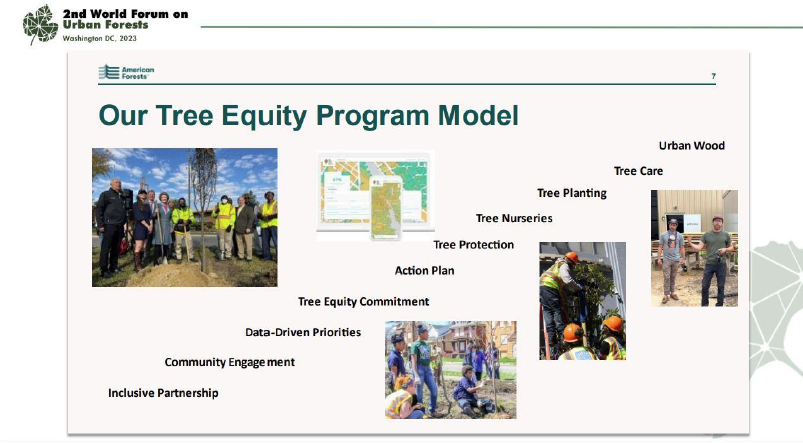
Presentation slide of Tree Equity programme model by Jad Daley (photo: American Forests)
Day 3 – Resilient Cities
Our urban trees are hard-working; their canopies are critical for cleaning the air, providing shade, and helping with the cooling-effect to make our cities more liveable. But trees and communities are constantly at risk from a changing climate, natural disasters, fires, droughts, even war. Day three looked at how we can enhance the resilience of our urban forests, cities and communities to these future shocks and stresses. Many global examples
were shared with delegates, where cities and communities have adapted to the traumas being experienced and built resilience in a variety of ways.
But for me, the engagement of Ukrainian communities, by Oleksandra Khalaim and her ecological group, Green Wave (https://ecoclubua.com) to undertake Urban Forest surveys despite the atrocious working conditions and terror of the Russian invasion, is a presentation I will never forget!
After the shock of Russia invading their country on 24th February 2022, this brave and determined group of environmentalist leaders decided they wanted to continue with their i-Tree ECO surveys with local stakeholders and unite around their common goal – to be useful to Ukrainian society and fulfil their mission which is educating and enlightening people, aiming to preserve and minimize the negative impact on the environment whilst taking care of the present and the future of humankind. For safety reasons, they had to pivot their whole project; no work could continue in eastern Ukraine, so delivery had to focus on western regions only. All data had to be saved to ‘cloud’ technologies rather than on physical devices, which tended to get destroyed in bombings. The training of community volunteers took place online rather than in-person; nearly 1000 trees were inventoried by more than 350 volunteers during the pilot inventories, which they hope to implement wider when circumstances allow.

Even under war conditions, these volunteers still wanted to assess the ecosystem services of their trees. You must ask, how is it possible to build such resilience under these dangerous wartime conditions? Oleksandra shared that communities wanted to shift their focus from
war to public activism to feel alive, to live a meaningful life, and to take care of themselves and their communities through caring for the trees. Oleksandra will be sharing her story with me at the ICF #members’ hour on 30th May, 2024 at 11am which I hope many of you will join.
A day of Field trips to inspire Thank goodness we had the shade of the trees to keep us cool whilst exploring the US National Arboretum, one of many field trips that participants could sign-up to. Established in 1927 by an act of Congress, the US National Arboretum covers 180 hectares. We were introduced to the Friends of the National Arboretum and the valuable work they undertake. We heard about plant-breeding programmes and long-term botanical research, but it was the stunning Gotelli Conifer Collection with over 2000 specimens of dwarf and slow-growing conifers with its Japanese maples, dwarf pines and crapemyrtles that captured our interest the most. I learned that William Gotelli wasn’t a scientist, but a building contractor with a passion for conifers which he had collected over 15 years as a hobby from all over the world, creating one of the largest collections which he donated in 1962. The field trips gave us time to connect with other delegates, share experiences and learn from each other.

Concluding thoughts
Conferences can be inspiring, and I met some wonderful people and trees during my week in Washington DC. I came away feeling more connected with professional networks, current thinking, and latest evidence-based research, with a renewed energy and passion to inspire change in London where I work. The UN predicts that two thirds of the world’s population is projected to live in urban areas by 2050. It seems to me that now is the time to take action to create greener, more sustainable, resilient and healthier cities where the benefits that trees and green spaces provide are universally available to, and appreciated by, all communities.
I find it encouraging that we are part of a global community of innovators, researchers, educators, leaders, policy-makers, and champions of urban and community forestry, united through our love of trees and wanting the best for our communities. But our urban forests need skilled arboriculturists and foresters to continue working and learning together, driving up standards, fostering partnerships, sharing knowledge, and inspiring the next generation of tree professionals to join our sector to help us make our cities greener, healthier and happier.
I wish everybody had an opportunity to attend an international conference; fortunately, we can connect with other professionals through membership networks, the urban forestry group on LinkedIn, and the European Forum on Urban Forestry (https://efuf.org) where information is easily accessible. I am deeply grateful for the Fund4Trees bursary (https://fund4trees.org.uk), Institute of Chartered Foresters EST educational grant (https://www.charteredforesters.org) and the Forestry Commission for financial support to attend the WFUF. If you want to talk to me about any ideas my email is Pherenice.worseybuck@forestrycommission.gov.uk or connect with me on LinkedIn.
 Fund4Trees